
The Book That Changed How I Think About a Small Garden Space
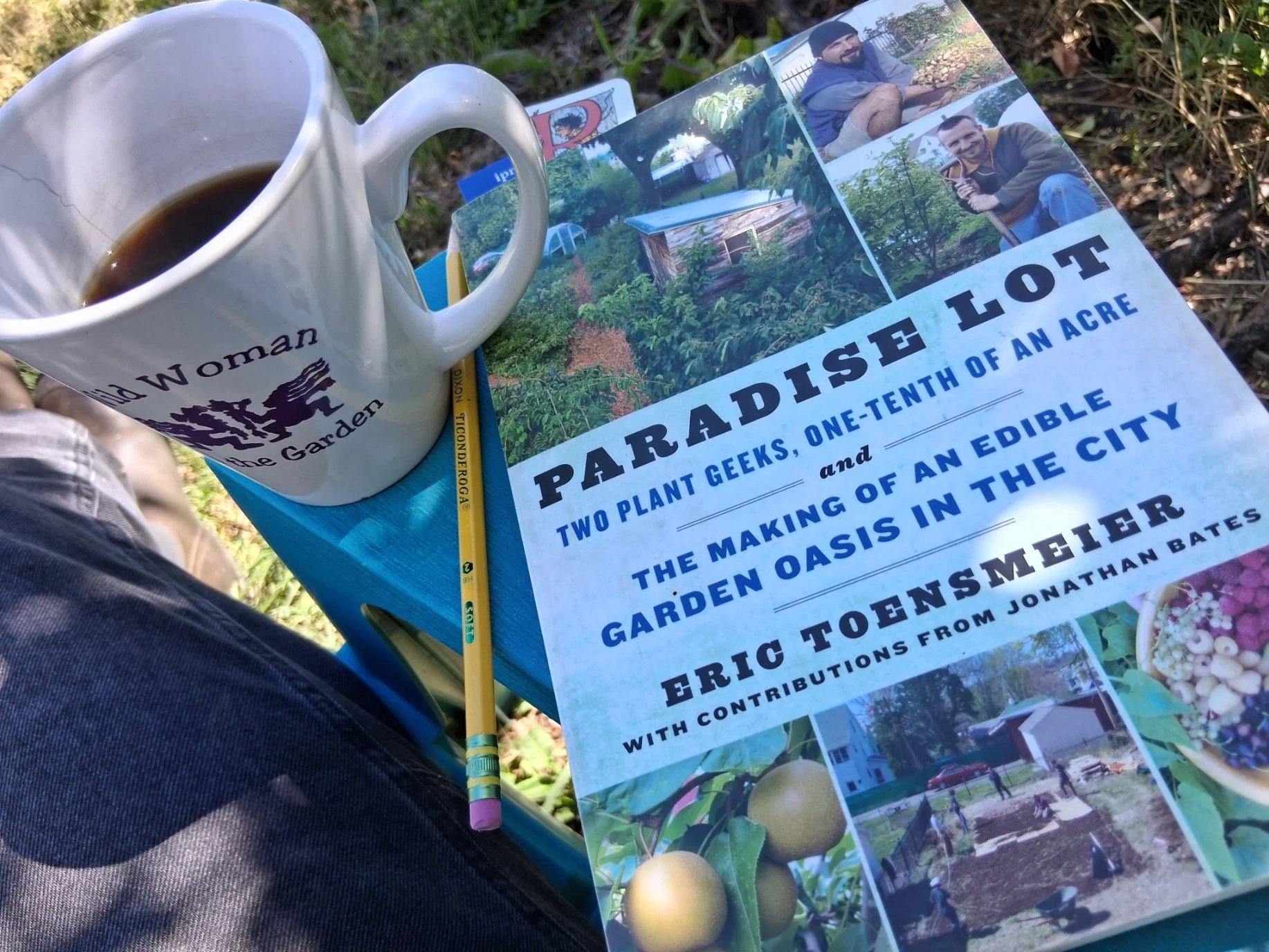
Every so often a book comes along that doesn't just teach you something — it reframes how you see what's already in front of you. For me, as a gardener and a Permaculture Design Consultant, Paradise Lot by Eric Toensmeier is one of those books.
The premise sounds almost impossible: Toensmeier and his partner transformed a tenth of an acre of compacted urban soil in Holyoke, Massachusetts into a thriving, productive food forest with over 200 edible species. Not a farm. Not a rural property. A small urban lot in a post-industrial city — and it fed them.
If you have ever looked at your Nevada County backyard and wondered what's actually possible there, this book will answer that question in the most generous way imaginable.
What it teaches.
The deepest lesson in Paradise Lot isn't about plants. It's about thinking in systems rather than individual crops. Toensmeier doesn't plant a tomato and a basil next to each other because a chart told him to. He designs a space where every plant has a function — some fix nitrogen, some attract pollinators, some provide ground cover, some climb vertically to use space that would otherwise be wasted. Every element serves multiple purposes. The garden does more work than any individual plant could do alone.
This is permaculture thinking applied at the scale of a home garden — and it's directly applicable to what most of us are working with in the Sierra Foothills. You don't need an acre. You need a design that respects the relationships between things.
The book also normalizes the long game. Toensmeier's food forest didn't produce abundantly in year one. It was designed, planted, tended, and observed over many seasons — each year building on the last. This is a different relationship with a garden than most of us were taught to have, and it's a more honest and ultimately more rewarding one.
Who it's for.
Paradise Lot is for the gardener who is ready to think beyond the raised bed. If you are in your first season and still figuring out what to plant and when, start with the basics and come back to this book in a year or two. It will mean more when you have some seasons behind you.
But if you find yourself wanting more from your space — more layers, more abundance, more of that feeling that your garden is alive and self-sustaining rather than something you have to constantly manage — this is the book. It will give you a vision worth working toward.
What comes through on every page is his genuine delight in what plants do when you give them the right conditions and get out of the way. That delight is contagious. It's what companion planting, succession planting, and building a garden that works with your real life are all pointing toward — a space that has its own momentum, its own intelligence, its own beauty.
Paradise Lot shows you what that looks like at its fullest expression. Even on a tenth of an acre. Even in difficult soil. Even starting from nothing.
There is no shortage of gardening advice on the internet. Most of it is generic, much of it is contradictory, and very little of it knows anything about your specific yard, your soil, or the particular rhythms of growing food in the Sierra Foothills. Books are different. A good gardening book was written by someone who spent years learning something deeply — and distilled it into something you can sit with, return to, and apply slowly. I recommend them carefully and only when I've found them genuinely useful.
On my reading list
Gaia's Garden by Toby Hemenway
I've started this one and already I can see why it's considered the home-scale permaculture guide. Hemenway writes for people with a backyard, not a farm — practical, grounded, and full of the kind of thinking that makes you want to go outside and redesign everything.
The Market Gardener by Jean-Martin Fortier
I've started this one too — and it's as precise and disciplined as Fortier himself was when I heard him speak at a local food and farm conference. More small farm than home garden, but the systems thinking is extraordinary. Worth knowing even if you never intend to sell a single head of lettuce.
Braiding Sweetgrass by Robin Wall Kimmerer
Reviews describe it as part botany, part memoir, part philosophy — an indigenous botanist's meditation on what plants give us and what we owe them in return. It keeps showing up in the hands of gardeners I respect. That's enough for me.
The Living Soil Handbook by Jesse Frost
Everything reviewers say points to the same thing — this is the book for understanding what's happening beneath your feet. Accessible, practical, and built around the idea that healthy soil is the foundation of everything else. On the list for this reason alone.
Good books give you the thinking. Guided gives you someone to think alongside — in your actual garden, in your specific Nevada County microclimate, working through the real decisions your space requires.
If you want someone to show up in your garden and help you actually do this — that's Guided. Four weeks, your yard, your harvest. Book a free Garden Chat to see if it's a fit.
Want more Nevada County gardening advice specific to our Sierra Foothills climate? I send one email every Wednesday — seasonal, practical, and built for where we live. → Join the newsletter here
Ellie is a third-generation kitchen gardener, Certified Garden Coach, and Permaculture Design Consultant with 25 years of growing in Western Nevada County. She tends a one-acre homestead in Grass Valley with her two cats, chickens, and honeybees. She can also be found volunteering in her community as a Master Gardener of Nevada County.
Her work is rooted in a simple belief — that every woman who grows her own food carries that knowledge forward into her home, her community, and the next generation.
If you're ready to carry that knowledge forward in your own backyard, she'd love to help you get started.
