

How to Harvest From Your Nevada County Garden All Season — Not Just Once
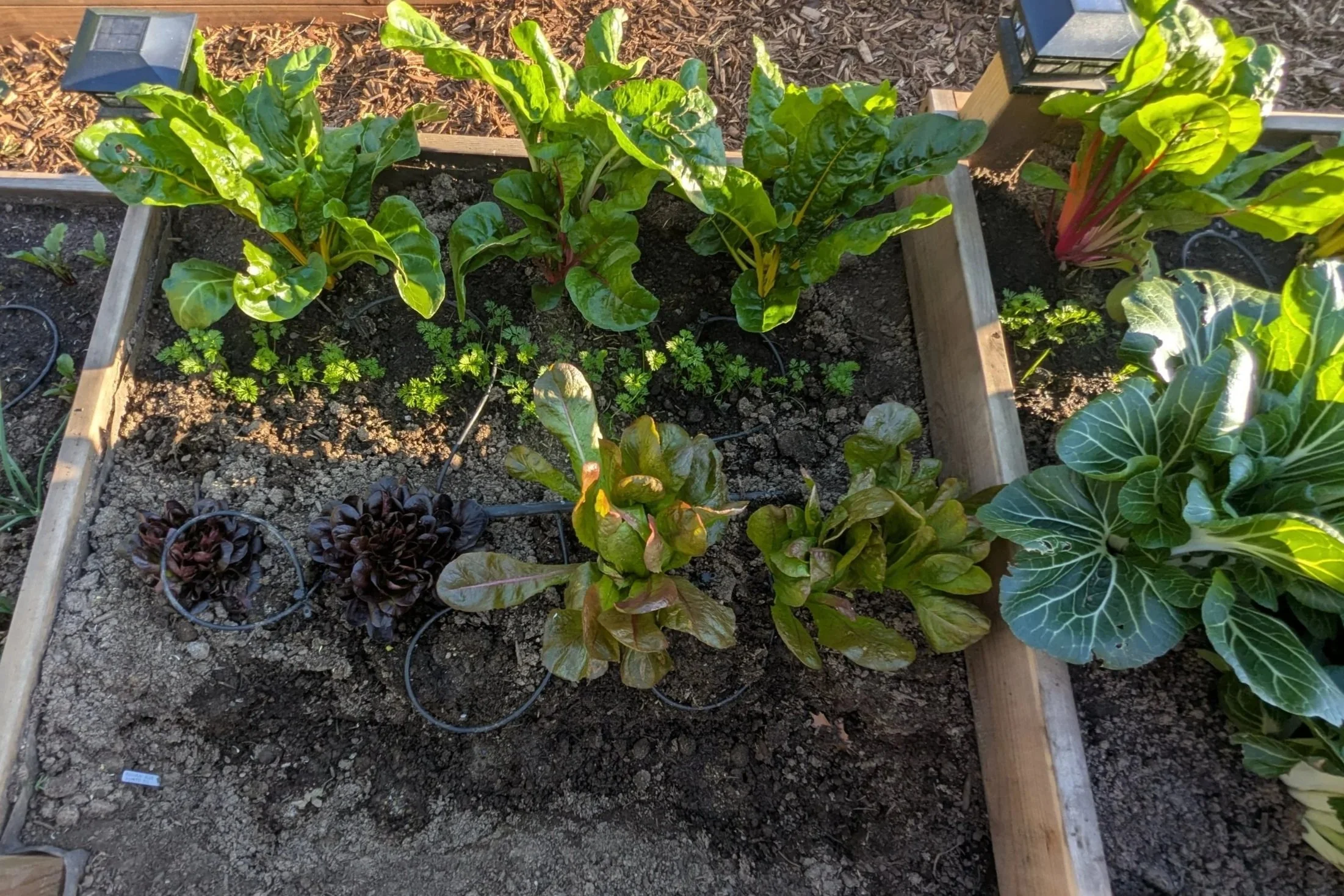
Cool Season Leafy Greens with room for next weeks planting.
Last week I was on my hands and knees transplanting this season's addition to the strawberry patch, warm sun and cool soil for company, when my cat Wyatt joined us. He was quick to remind me that work can be play — digging little holes alongside me, chasing a moth, and leaping on a long stem of grass I'd just pulled from the bed. He had no agenda except delight.
There's something in that worth holding onto as we approach the busiest planting weekend of the Nevada County calendar. Because the gardener who plants everything at once in one ambitious weekend, then stands back and waits — she's working harder than the one who treats the garden like a slow, pleasurable conversation that runs all season long.
That's succession planting. And it's the difference between a garden that bombards you with produce for two or three weeks in June and one that feeds you all the way through October into November.
What succession planting actually means.
It's simple: instead of planting everything at once, you plant in small batches every two to three weeks. The first batch goes in now. The second goes in when the first is a few inches tall. The third goes in when the second is established. Each batch matures at a different time, which means you're harvesting continuously instead of all at once.
Think about lettuce. If you plant one full bed in April, you'll have more salad than you can eat for three weeks — and then it bolts in the heat and it's over. But if you plant a short row every two weeks from April through June, you'll be cutting fresh lettuce from May all the way to the end of summer. Same amount of seed. Same amount of space. Completely different result.
What works best for succession planting in the Sierra Foothills right now.
Cool-season crops are your succession stars at this point in the season — lettuce, spinach, arugula, radishes, and cilantro all mature quickly and respond beautifully to staggered planting. Start your first batch now, your second in two weeks, your third in four weeks. By the time the heat arrives and the cool-season crops are done, your warm-season plants will be taking over.
Warm-season crops — tomatoes, zucchini, peppers, and beans — wait until the week before Mother's Day weekend, our classic Nevada County planting date, when the risk of a late frost has passed. Those get their own succession rhythm once they're in the ground.
The one thing that makes succession planting stick.
A planting calendar. Not a complicated one — just a simple record of what went in, when, and where. Without it, succession planting becomes a vague intention that gets lost in the busyness of summer. With it, you walk outside every two weeks, put in a short row, and feel the quiet satisfaction of a garden that's always one step ahead of you.
This is one of the things I build with every client in the first weeks of working together — a planting calendar specific to their space, their crops, and their schedule. Because knowing what to plant is only half of it. Knowing when is what keeps the harvest coming all the way through fall.
If you want help building yours — the free Nevada County Planting Guide is a good place to start. → Grab it here
And if you'd like someone to show up in your actual backyard, work alongside you, and take the guessing out of it completely — book a free Garden Chat. That's where we start.
Ellie is a third-generation kitchen gardener, Certified Garden Coach, and Permaculture Design Consultant with 25 years of growing in Western Nevada County. She tends a one-acre homestead in Grass Valley with her two cats, chickens, and honeybees. She can also be found volunteering in her community as a Nevada County Master Gardener.
Her work is rooted in a simple belief — that every woman who grows her own food carries that knowledge forward into her home, her community, and the next generation.
If you're ready to carry that knowledge forward in your own backyard, she'd love to help you get started.
