
The dining table has disappeared under canning jars, pens and a gathering of paper bags. Dried stalks have been waiting in those bags and in a few pillowcases since the first harvests, and November is when the waiting ends. Wyatt has claimed my lap at the table while labels get written and inventory counts get filled in.
Saving seeds can sound like a science project, and the bags keep piling up because the next step is unclear. Dried stalks take up space, and the seeds inside are free. The job comes down to three moves. Clean the seeds, get the seeds into a jar, and label and record the seeds.
Let everything dry first
Seeds that go into a jar damp will mold. Bean pods should rattle, seed heads should feel crisp, and stalks should snap instead of bend. Paper bags and pillowcases work well for this part of drying because air can still move through them. A dry spot indoors or under cover is enough.
Crush the big seeds, then pick out the pieces
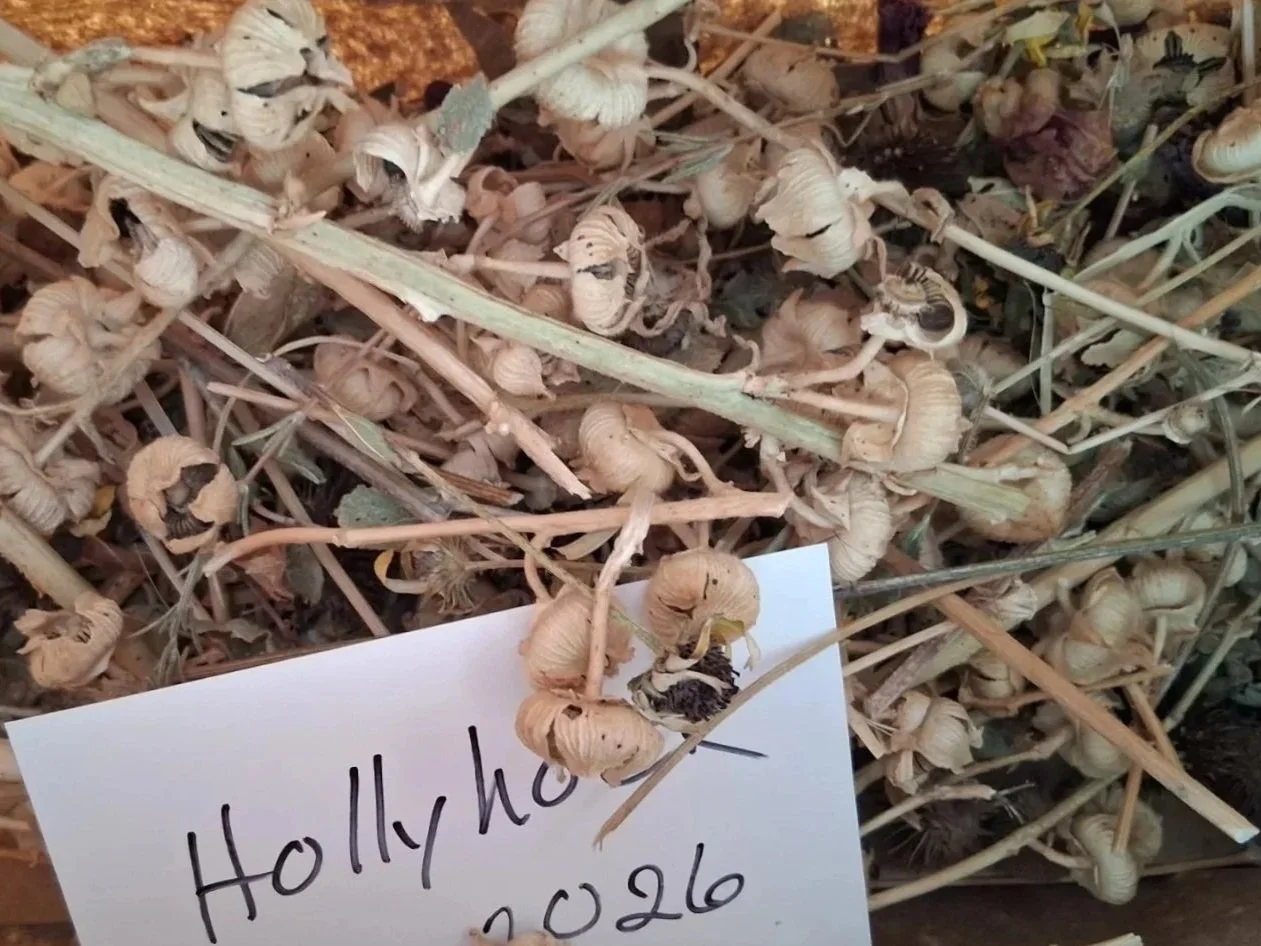
Beans and hollyhocks are the easy ones. Crush the dried pods and seed heads right inside the bag or pillowcase, then pour everything onto a tray. The seeds are the heavier, smoother pieces. The larger bits of stalk, husk and pod can be picked out by hand and sent to the compost.
Winnow the small seeds
Onion and radish seeds are too small to pick clean by hand, so these get a bit of winnowing. Winnowing means using moving air to separate light chaff from heavier seed. Pour the seeds slowly from one bowl into another in a gentle breeze, or give the tray a few soft breaths, and the chaff drifts away while the seeds drop. Repeat until the pile looks clean. A few specks are fine. A pile of debris is what invites trouble in storage.
Jar it, label it, count it
Canning jars make good seed storage. Fill each jar once the seeds feel fully dry, then label it with the crop, the variety and the year. The inventory list gets filled in at the same moment, because the number of jars is easy to forget by January. A cool, dark, dry spot keeps the seeds ready for spring.
Know which seeds will come true
Beans mostly pollinate themselves, which makes them a forgiving place to start. Squash and cucumbers are a different story. Bees carry pollen between varieties, and the seeds may grow into plants that look nothing like the parent. Seeds saved from hybrid plants have the same problem. When the parentage is uncertain, buy fresh seed and save the jars for the sure things.
Test before planting
After the holidays, the seeds headed back into the ground get a viability test. Count ten seeds onto a damp paper towel, slide it into a bag, set it somewhere warm, and check every few days for a week or two. Eight sprouts out of ten is an 80 percent germination rate, which is plenty good. Write the result on the jar label. The numbers feed straight into the plan from Planning Your 2027 Nevada County Vegetable Garden Now.
A quiet job for a quiet month
In my garden, the beans and hollyhocks get crushed and cleared of the larger debris, and the onions and radishes get a bit of winnowing. Then everything goes into canning jars with a label and a count. It is a gentle project that keeps a gardener in tune with the garden even when there is nothing to do outside. By the time the first catalogs arrive, the table is clear and the jars are lined up and ready.
Want more Nevada County gardening advice specific to our Sierra Foothills climate? I send one email every Wednesday — seasonal, practical, and built for where we live. → Join the newsletter here
Ellie is a third-generation kitchen gardener, Certified Garden Coach, and Permaculture Design Consultant with 25 years of growing in Western Nevada County. She tends a one-acre homestead in Grass Valley with her two cats, chickens, and honeybees. She can also be found volunteering in her community as a Master Gardener of Nevada County.
Her work is rooted in a simple belief — that every woman who grows her own food carries that knowledge forward into her home, her community, and the next generation.
If you’re ready to carry that knowledge forward in your own backyard, she’d love to help you get started.
